
Non-resident Indians (NRIs) in the Gulf region are increasingly purchasing term life insurance policies from India, driven by geopolitical uncertainties in West Asia and the significant cost advantages offered by Indian products, with the GCC region now contributing over half of the total NRI demand.

New business premium of life insurance companies grew 18 per cent year-on-year (Y-o-Y) to Rs 35,417 crore in February, driven by robust growth at the state-owned Life Insurance Corporation of India (LIC) due to a favourable base.

The committee formed under the Life Insurance Council to review the commission structure in the life insurance sector has recommended capping distributor commissions or deferring them to ease acquisition costs. The recommendations will be sent to the insurance regulator -- Insurance Regulatory and Development Authority of India (Irdai).
The life insurance industry recorded nearly 40 per cent year-on-year (Y-o-Y) growth in new business premiums (NBP), aided by the rationalisation of goods and services tax (GST) on individual life insurance premiums, which has made policies more affordable for consumers.
New business premiums of life insurance companies dropped 5.2 per cent year-on-year (YoY) in August to Rs 30,959 crore, owing to a double-digit decline reported by state-owned Life Insurance Corporation (LIC), data from the Life Insurance Council showed. LIC recorded a 17 per cent YoY fall in new business premiums to Rs 16,023 crore during the month, while private life insurers reported a 12 per cent YoY increase to Rs 14,936 crore.
Life insurers shifted their focus to selling high-value policies in October as the transition to new surrender value norms, effective October 1, limited their ability to roll out all products in their portfolio. This led to a 40 per cent year-on-year (Y-o-Y) drop in the number of policies sold in October. Additionally, distributors engaged in a fire sale of policies in September due to uncertainty about the impact of the new norms on their commission structures.

Life insurance companies reported a 13.16 per cent year-on-year (Y-o-Y) growth in new business premium (NBP), totting up Rs 30,347 crore in October, even as the number of policies sold saw a sharp decline. The growth was largely driven by strong performance from private sector life insurers.

The new business premium (NBP) of life insurance companies dropped 21.7 per cent year-on-year (Y-o-Y) to Rs 30,218.71 crore in December 2024 on the back of a steep fall in business. According to data published by the Life Insurance Council, LIC's premium dropped 41.15 per cent Y-o-Y to Rs 13,523.87 crore while private insurers reported 7 per cent growth in NBP to Rs 16,694.85 crore as the industry absorbs the impact of the revised surrender value norms.
The life insurance industry reported a 25.28 per cent decline in new business premium income in November 2023 to Rs 26,494.83 crore from Rs 34,588.8 crore recorded a year ago. The fall in group premium and change in taxation norms for policies with a higher ticket size dragged the premiums of the state-run Life Insurance Corporation of India (LIC) and private insurers, respectively. According to the data released by the Life Insurance Council, the premium of private insurers slipped 9.33 per cent Y-o-Y to Rs 10,360.29 crore from Rs 11,426.73 crore as a result of a change in product mix due to the measures taken to counter the impact of tax imposed on the premiums of Rs 5 lakh.
Both the life and non-life insurance segment posted over 20 per cent premium growth in November for the first time in this financial year (FY26), supported by the reduction in goods and services tax (GST) on premiums from 18 per cent to zero and a favourable base effect.

Recent years have been turbulent for the insurance industry due to direct and indirect tax reforms, regulatory overhaul and other external pressures. The events cumulatively slowed growth rate to single digits from the high teens seen earlier.

Data released by the Life Insurance Council reveals that the total pension premium for the life insurance industry saw a growth of 159 per cent at Rs 22,268 crore (Rs 222.68 billion) for FY07 compared with Rs 8,568 crore (Rs 85.68 billion) in FY06.

The Life Insurance Council has made a representation to the Insurance Regulatory Development Authority (Irda), seeking some revisions pertaining to unit-linked products.
The Life Insurance Corporation of India has the wherewithal to acquire a composite license, a top source aware of the development told Business Standard, adding that the insurance behemoth may look into entering the health and general insurance segments. "LIC has the scale, capacity, IT infrastructure, and the distribution reach to take advantage of the composite license. "LIC is looking at organic as well as inorganic growth opportunities.

Even as non-life insurers reported muted premium growth in October, standalone health insurers saw a robust 38 per cent year-on-year (Y-o-Y) surge. This growth was driven by pent-up demand in the retail health insurance segment.

As of March 25, life insurers have paid Rs 1,986 crore towards 25,500 Covid death claims

Section 45 in the new Bill says no claim can be repudiated after three years of the policy being in force, even if a fraud is detected, has sent life insurers into a tizzy.

India has received nearly Rs 30,000 crore worth of FDI in the private sector insurance firms since 2015, when the government had increased FDI limit from 26 per cent to 49 per cent. Investment under the automatic route does not require prior approval from the government.

Finance Minister Nirmala Sitharaman on Tuesday said that raising the FDI limit to 100 per cent in the insurance sector will help attract more capital, improve competition and increase insurance penetration by making policies more affordable.
Health premiums have picked up again after a slight moderation in growth, taking the non-life insurance industry's growth to 22 per cent in November, and to almost 17 per cent so far this financial year. Health premiums grew by 22.54 per cent in the April-November period, driven largely by group health plans, which have seen good growth due to rationalisation of discounts in premiums caused by adverse claim ratios in prior periods, medical inflation, and enhanced coverage. Health premiums grew by 29 per cent in the same period last year.

As heart disease increasingly impacts young Indians, understanding the complexities of health insurance, including higher premiums, waiting periods, and the benefits of specialised cardiac policies, becomes vital for financial protection.

Section 45, which says no claim can be rejected after three years of a policy being in force, remains a bone of contention
Life insurance companies reported a 17 per cent year-on-year (YoY) drop in new business premium (NBP) in February as state-owned Life Insurance Corporation of India's premiums contracted 32 per cent during this period on account of a drop in its group single premium segment. According to data released by the Life Insurance Council, the industry earned an NBP of Rs 22,847.65 crore in February - a drop of 17 per cent from the same period a year ago.
The Centre has proposed exempting life and health insurance policies for individuals from GST, Bihar Deputy Chief Minister and convenor of insurance GoM Samrat Choudhary said on Wednesday. Currently, health and life insurance premium attracts 18 per cent GST.

The non-life insurance industry has received over 1 million Covid-related claims in the first quarter of the current fiscal year (Q1FY22), higher than in the entire FY21, indicating the severity of the second wave of the pandemic. According to the General Insurance Council data, which is not publicly available, non-life insurers have received 1.22 million Covid-related claims so far in FY22 and have settled 944,573 of those worth Rs 9,178 crore. In comparison, they had received 986,366 Covid claims in FY21 and settled 849,034.

While initially, the claim amount was high, it has now moderated with many states prescribing a standard treatment rate for Covid-19. Of the total claims received, nearly 66,000 claims amounting to Rs 628.95 crore have been settled so far.

The GST Council, in its meeting on Saturday, is likely to decide on reducing tax rates on life and health insurance premiums, while hiking it on high-end wrist watches, shoes and apparels, besides considering a separate 35 per cent tax slab for sin goods. The 55th meeting of the GST Council, chaired by Union Finance Minister Nirmala Sitharaman and comprising state counterparts, is likely to discuss rate rejig in about 148 items, besides, it will also deliberate on bringing Aviation Turbine Fuel (ATF), a major component for airline industry's operation cost, in the Goods and Services Tax (GST) fold.

Male central government employees are entitled to 15 days under service rules and provisions in the private sector depends on the company's policy.
'Investment by insurers in the Bima Sugam India Federation is illegal as it is a private limited company.'

New India Assurance and Niva Bupa have invested in the Bima Sugam India Federation.

'LIC will reduce but not fully exit its stake in IDBI Bank, which remains an important bancassurance partner,' says LIC of India' MD and CEO R Doraiswamy.
'It is imprudent on the part of Indian insurance companies to invest out of the shareholders' fund in a private limited company.'
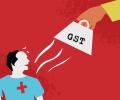
Reduction of GST on health insurance premium from 18% to 0% looks like a straight 18% reduction in what consumers pay. The truth, however, is...

Some of the key names include: Maruti, M&M, Ashok Leyland, Britannia, Ultratech, JK Cement, Havells, Voltas, Amber, Metro, Trent, LemonTree, Indian Hotels, Niva Bupa, HDFC Life, IGL, Acme Solar, Suzlon, Swiggy, Delhivery, ICICI Bank, HDFC Bank, Bajaj Finance, Shriram Finance," according to a report by Motilal Oswal Financial Services.

Full exemption for all health insurance premiums and reinsurance or a reduction in the GST rate from 18% to 5% on health insurance services is likely.

Victory wrested from regime that only listens when forced, the TMC said on GST exemption on insurance.
Insurance companies reported nearly 23 per cent growth in first year premium in the first quarter of financial year 2024-25, when compared to the same period last year, with market leader LIC leading the charge with 28 per cent growth. According to the data released by the Life Insurance Council, the new business premium (NBP) increased by 22.91 per cent year-on-year (Y-o-Y) to ~89,726.7 crore in Q1FY25 from ~73,004.87 crore in Q1 FY24, reflecting a robust demand for insurance policies in the country.
Contrary to expectations, the new business premium (NBP) of life insurance companies dropped 12.62 per cent year-on-year (YoY) in March 2023 due to an over 30 per cent drop in Life Insurance Corporation (LIC) of India's premiums, albeit on a high base. Data released by the Life Insurance Council shows the industry racked up NBP of Rs 52,081 crore in March 2023, compared with Rs 59,608.83 crore in the year-ago period. NBP is the premium acquired from new policies in a year. It is the sum of the first-year premium and single premium, reflecting the total premium received from new businesses.
The code of market conduct is being prepared under the aegis of the General Insurance Council (a self-regulatory body of the 12 non-life insurance companies) in this regard.
Insurance industry emerged as the largest investor in the stock market during 2007-08 surpassing the foreign institutional investors, riding on the huge popularity of Unit Linked Insurance Products, according to Life Insurance Council.
